
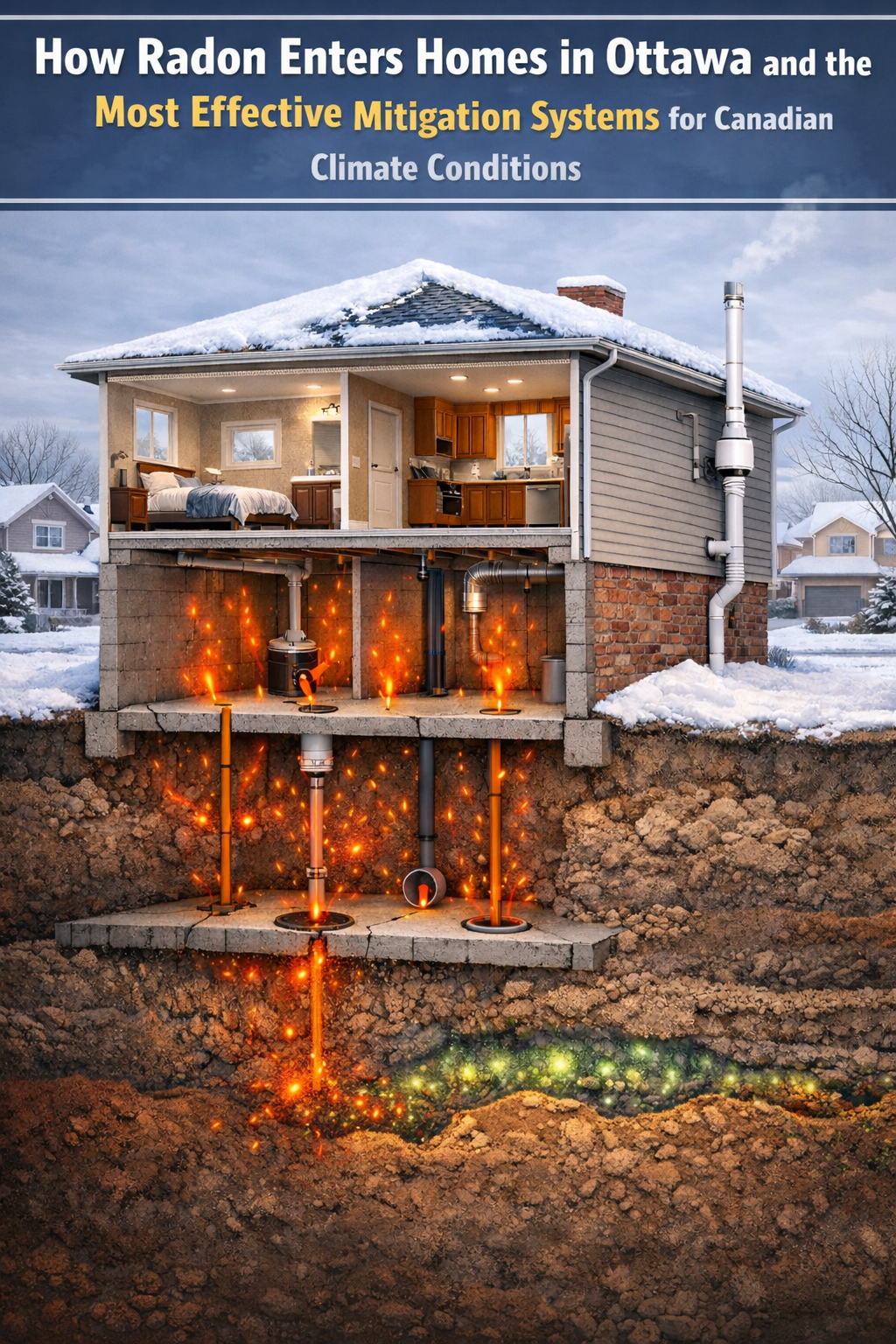
Radon gas is an invisible threat present in thousands of homes across Ottawa and throughout Canada. Many homeowners are unaware that their property may contain elevated radon levels, putting their families at long-term risk. Because radon cannot be seen, smelled, or tasted, it often goes undetected for years unless proper testing and mitigation measures are taken.
Understanding how radon enters homes—and how modern mitigation systems work in Canada’s unique climate—is essential for protecting your family, improving indoor air quality, and maintaining property value.
This comprehensive guide explains the science behind radon infiltration, why Ottawa homes are particularly vulnerable, and the most effective radon mitigation systems available today.
What Is Radon and Why Is It Dangerous?
Radon is a naturally occurring radioactive gas formed when uranium in soil, rock, and groundwater breaks down over time. This process happens naturally across the Earth’s surface and is especially common in areas with certain geological compositions, including parts of Ontario.
Radon becomes dangerous when it accumulates indoors.
According to Health Canada, radon is the leading cause of lung cancer among non-smokers and the second leading cause overall after smoking. Long-term exposure increases cancer risk significantly, especially when levels exceed recommended safety thresholds.
Radon gas decays into radioactive particles. When inhaled, these particles can damage lung tissue, increasing cancer risk over time.
Key facts:
- Radon is invisible and odorless
- It exists naturally in soil everywhere
- It can accumulate inside homes
- Risk increases with long-term exposure
- Mitigation is highly effective and affordable
Why Ottawa Homes Are Particularly Vulnerable to Radon
Ottawa and surrounding regions have geological and environmental conditions that increase radon exposure risk.
1. Local Geological Conditions
Ottawa sits on soil and bedrock containing uranium deposits. As uranium breaks down, radon gas is released continuously.
Areas with:
- Granite bedrock
- Clay soil
- Fractured rock formations
are more likely to produce radon.
These conditions exist in many Ottawa neighborhoods.
2. Canadian Climate and Seasonal Effects
Canada’s cold winters significantly increase radon accumulation indoors.
During winter:
- Homes are sealed tightly to conserve heat
- Windows remain closed
- Indoor air pressure becomes lower than soil pressure
- Radon is pulled inside more aggressively
This creates a “vacuum effect,” drawing radon into basements and lower levels.
3. Modern Energy-Efficient Construction
Energy-efficient homes are excellent for heating efficiency but can trap radon inside.
Features like:
- Airtight insulation
- Sealed windows
- Weatherproofing
- Reduced ventilation
limit fresh air exchange, allowing radon to accumulate.
Ironically, newer homes may have higher radon levels than older ones.
4. Basements and Foundations
Most radon enters through basement foundations because they are in direct contact with soil.
Homes in Ottawa often have:
- Full basements
- Finished basements
- Crawl spaces
These areas are primary entry points for radon.
How Radon Enters Homes: The Complete Breakdown
Radon enters homes through multiple pathways. Even well-built homes are vulnerable.
1. Foundation Cracks
Small cracks in concrete foundations provide easy entry points.
Cracks form naturally due to:
- Soil shifting
- Temperature changes
- Foundation settling
- Structural stress
Even microscopic cracks allow radon entry.
2. Floor-Wall Joints
The joint where the basement floor meets the wall is a common entry point.
These joints often have small gaps that allow soil gases inside.
3. Gaps Around Pipes and Utilities
Openings around:
- Plumbing pipes
- Electrical conduits
- Drain pipes
- Sump pits
allow radon infiltration.
These areas often remain unsealed.
4. Sump Pits
Sump pits are direct openings into soil beneath the home.
If not properly sealed, sump pits can be major radon entry sources.
5. Porous Concrete
Concrete is not completely solid. It contains microscopic pores that allow gases to pass through.
Radon can slowly seep through concrete floors and walls.
6. Crawl Spaces
Homes with crawl spaces often have exposed soil or insufficient sealing.
This allows radon to accumulate and enter living spaces.
7. Well Water (Rare but Possible)
Radon can dissolve in groundwater and enter homes through well water.
This is more common in rural areas around Ottawa.
Why Radon Accumulates More in Basements
Basements typically have the highest radon levels because they are closest to the source: soil.
Additional reasons include:
- Lower air circulation
- Higher air pressure difference
- Direct soil contact
- Limited ventilation
Radon rises upward from basements to upper floors over time.
Radon Levels Can Vary Significantly Between Homes
Even neighboring homes can have vastly different radon levels.
Factors include:
- Soil composition
- Foundation type
- Construction quality
- Ventilation
- House pressure differences
Testing is the only reliable way to know radon levels.
Health Canada Radon Safety Guidelines
Health Canada recommends mitigation when radon exceeds:
200 Becquerels per cubic meter (Bq/m³)
Risk increases as levels rise.
Typical ranges:
- 0–100 Bq/m³: Low risk
- 100–200 Bq/m³: Moderate risk
- 200–600 Bq/m³: High risk
- 600+ Bq/m³: Very high risk
Many Ottawa homes exceed recommended levels.
The Most Effective Radon Mitigation Systems in Canada
Fortunately, radon mitigation systems are extremely effective.
Professional mitigation reduces radon levels by up to 99%.
The most common and effective system is:
Active Soil Depressurization (ASD)
This is the gold standard radon mitigation method in Canada.
How Active Soil Depressurization Works
The system uses a specialized fan and pipe to remove radon gas from beneath your home.
Steps:
- A pipe is inserted through basement floor or slab
- The pipe reaches soil beneath foundation
- A radon fan pulls gas from soil
- Gas is safely vented outside above roof level
- Radon is prevented from entering the home
This creates negative pressure beneath the home, blocking radon entry.
Why ASD Works So Well in Ottawa
ASD systems are ideal for Canadian homes because:
- They work in cold climates
- They function year-round
- They operate continuously
- They require minimal maintenance
- They provide long-term protection
Other Radon Mitigation Methods Used in Canada
While ASD is most effective, additional techniques improve performance.
Sealing Entry Points
Sealing cracks and openings reduces radon entry.
Common areas sealed include:
- Floor cracks
- Wall cracks
- Pipe openings
- Sump pits
Sealing alone is not sufficient but improves system effectiveness.
Sub-Membrane Depressurization (For Crawl Spaces)
Used when homes have crawl spaces instead of basements.
Process:
- Crawl space floor covered with sealed plastic membrane
- Vent pipe installed beneath membrane
- Fan removes radon gas
Highly effective solution.
Improved Ventilation
Ventilation reduces radon concentration indoors.
Methods include:
- Heat recovery ventilators (HRV)
- Mechanical ventilation systems
- Improved airflow circulation
Often used alongside ASD systems.
Components of a Professional Radon Mitigation System
Understanding system components helps homeowners appreciate how mitigation works.
Key components include:
Radon Pipe
PVC pipe transports radon safely outside.
Installed:
- Inside walls
- Outside exterior wall
- Through attic and roof
Radon Fan
The fan is the heart of the system.
It:
- Runs continuously
- Pulls radon from soil
- Uses minimal electricity
- Operates quietly
Typical cost to operate: $50–$100 per year.
Sealed Entry Point
The pipe entry point is sealed airtight.
Prevents radon leakage.
Exhaust Point
Radon is vented safely outside above roof level.
This prevents re-entry.
Monitoring System
Many systems include radon level monitors.
These confirm proper operation.
How Effective Are Radon Mitigation Systems?
Professional systems reduce radon levels dramatically.
Typical reduction:
- 70% to 99%
Most homes achieve safe levels below 200 Bq/m³.
Many reach levels below 50 Bq/m³.
How Long Radon Mitigation Systems Last
Radon systems are durable.
Typical lifespan:
- Fan: 5–10 years
- Pipes: 20+ years
- System overall: 20+ years
Minimal maintenance required.
Signs Your Ottawa Home May Have Elevated Radon
Radon has no visible warning signs.
However, risk factors include:
- Basement living spaces
- Older foundations
- Poor ventilation
- Nearby homes with radon issues
- Living in Ottawa region
Testing is the only reliable method.
Radon Testing Is the First Step
Before mitigation, testing must be performed.
Testing options include:
Short-Term Testing
Duration:
- 2–7 days
Provides quick results.
Long-Term Testing
Duration:
- 90 days or more
Most accurate method.
Accounts for seasonal variations.
Recommended by Health Canada.
Professional vs DIY Radon Mitigation
Professional mitigation is strongly recommended.
Professionals ensure:
- Proper system design
- Maximum effectiveness
- Safe installation
- Code compliance
DIY systems often fail to reduce radon sufficiently.
Radon Mitigation and Home Value
Radon mitigation improves home value and buyer confidence.
Benefits include:
- Easier home sale
- Higher property value
- Increased buyer trust
- Health protection
Many buyers request radon testing.
Mitigation provides peace of mind.
Radon Mitigation Is a Permanent Solution
Once installed, systems provide continuous protection.
They work:
- 24 hours per day
- Year-round
- Automatically
No daily action required.
Energy Efficiency and Operating Cost
Radon systems are energy efficient.
Typical electricity usage:
- Similar to a small light bulb
Annual operating cost:
- $50–$100
Minimal cost for major health protection.
Why Professional Radon Mitigation Matters in Ottawa
Ottawa’s climate, geology, and housing styles make professional mitigation essential.
Professionals understand:
- Local soil conditions
- Canadian building standards
- Cold climate installation requirements
- Optimal system design
Professional installation ensures maximum safety.
Why Choose Dr Clean Air for Radon Mitigation in Ottawa
Dr Clean Air specializes in radon mitigation services designed specifically for Ottawa homes.
Services include:
- Professional radon testing
- Custom mitigation system design
- Expert installation
- Post-installation testing
- Long-term support
Every home receives a tailored solution.
Protect Your Family from Radon Today
Radon exposure is preventable.
Mitigation systems provide:
- Immediate protection
- Long-term safety
- Improved air quality
- Peace of mind
Thousands of Ottawa homeowners have already reduced their radon risk.
Testing and mitigation are simple, affordable, and highly effective.
Conclusion
Radon is a serious but manageable health risk affecting many homes in Ottawa. Understanding how radon enters homes and how mitigation systems work empowers homeowners to take action.
The most effective solution—Active Soil Depressurization—removes radon at its source and protects your home year-round, even in Canada’s harsh winter climate.
Professional radon mitigation provides permanent protection, improves indoor air quality, and safeguards your family’s health.
Dr Clean Air is committed to helping Ottawa homeowners eliminate radon risks through expert testing, mitigation, and ongoing support.